











PortSide Stories: Ningbo-Zhoushan

PortSide Stories: Ningbo-Zhoushan
China’s Industrial Gateway to the World
The Port of Ningbo-Zhoushan sits on China’s eastern coastline. It is one of the busiest ports in the world. It moves massive volumes of containers, raw materials, and energy cargo every day. Ships arrive from global trade routes without pause. Cargo is processed, sorted, and pushed back into the global system. This is not just a port. It is a core engine of global manufacturing.
A Container Powerhouse
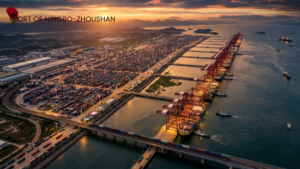
Ningbo-Zhoushan operates at extreme scale. It consistently ranks among the top ports globally for total cargo throughput. Ultra-large container vessels arrive daily. Deep-water channels allow fully loaded megaships to berth with ease.
Terminals are highly efficient and increasingly automated. Cranes operate in constant motion. Rail and road networks push cargo deep into China’s industrial heartland. Containers move out as fast as they come in. Speed and scale define the system.
China’s Growth Engine
This port sits at the center of the Yangtze River Delta economy. One of the most industrialized regions in the world depends on it. Electronics, machinery, textiles, and heavy manufacturing flow through here every day.
Ningbo-Zhoushan is a direct link between Chinese factories and global markets. Europe, Africa, the Middle East, and the Americas all connect through this node. It is a physical expression of China’s export power.
Life by the Coast
Ningbo is a working city with deep coastal roots. Industry dominates the skyline, but daily life stays close to the sea. Fishing communities still exist alongside modern logistics zones. The contrast is constant but natural.
Evening brings movement to streets and markets. The air fills with steam, smoke, and seafood grills. Life here is shaped by trade, tide, and tradition.
Local Flavors of Ningbo
Food in Ningbo is coastal and refined. It is known across China for its light, slightly sweet, and fresh seafood-based cuisine.
Dishes like steamed crabs, yellow croaker fish, and river shrimp define the local table. Broths are clear and delicate. Flavors are simple but precise.
A signature specialty is Ningbo tangyuan, soft rice balls often filled with sesame or peanut paste. Street food markets add energy with noodles, skewers, and quick seafood dishes served late into the night.
Here, food reflects the sea. Freshness is everything.
Culture and Contrast
Ningbo carries centuries of maritime trade history. It was one of China’s earliest coastal trading cities. Today, that legacy sits beside massive modern port infrastructure.
Ancient temples, old trading streets, and riverfront districts remain active within a fast-industrial environment. The city moves between heritage and acceleration without pause. Tradition and global trade coexist in the same space.
Sightseeing by the Sea
Ningbo offers a layered coastal experience. Tianyi Pavilion, one of China’s oldest libraries, holds centuries of preserved knowledge and cultural history. Also, Ningbo Old Bund shows riverfront architecture shaped by early international trade.
Don’t miss Dongqian Lake that provides a calm natural escape near the city. It contrasts sharply with the scale of industrial zones nearby.
Beyond the city, the Zhoushan Islands open into the East China Sea. Fishing villages, coastal cliffs, and quiet beaches show a slower maritime life. Here, the sea is still lived, not just traded.
Ningbo-Zhoushan in Motion
Cranes line the horizon in endless formation. Container stacks stretch across terminals. Mega-ships enter and exit without stopping. Railways and highways push cargo deep inland.
Ningbo-Zhoushan connects China’s industrial core to the world. It drives global manufacturing flow at scale. This is not just a port. It is one of the most important maritime gateways on Earth.
The post PortSide Stories: Ningbo-Zhoushan appeared first on Container News.
Content Original Link:
" target="_blank">